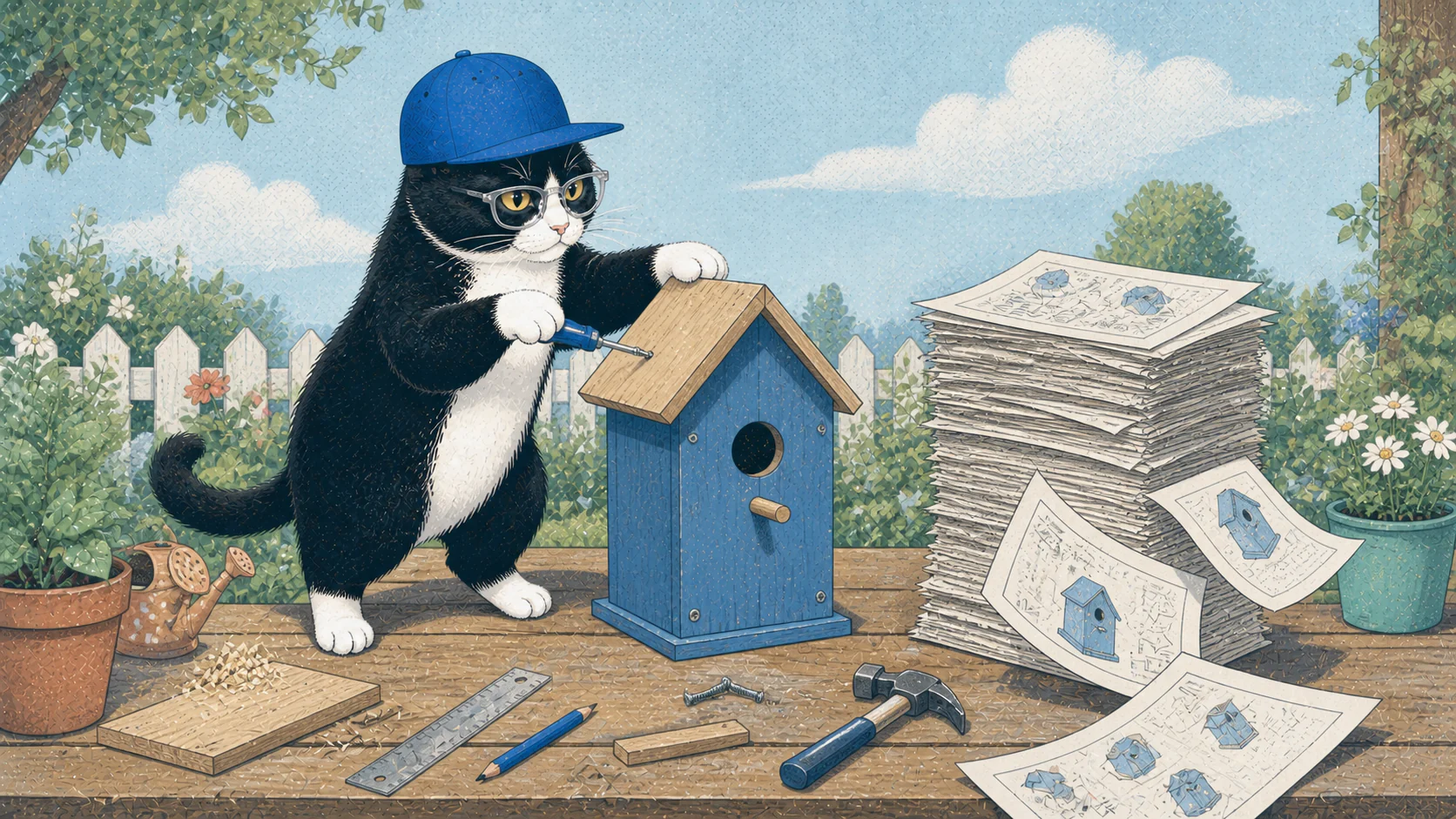
There is always one more tutorial to watch.
One more article to save. One more tool to compare. One more plan to improve before anything begins.
It looks like preparation. Sometimes it is preparation. Other times, it is fear wearing a sensible outfit.
Right now, some important next steps are being postponed while attention goes toward personal projects. That feels productive because real work is happening. A personal website is being built. Another idea is finally receiving the attention it has been waiting for.
But preparing for what comes next has been easier to avoid.
There are reasonable explanations for that. There is only so much time in a day. Building something feels more satisfying than confronting an uncertain future. Still, staying busy can also be another way to delay what feels uncomfortable.
The perfect plan is a hiding place
Feeling unready usually means waiting for a perfect plan.
Not just a useful plan. A complete one. Something certain enough to remove the possibility of failure.
That plan does not exist.
New projects rarely offer certainty. They begin with missing information, unfamiliar tools, and questions that cannot be answered until the work has already started.
Fear turns planning into an endless activity. Research feels safe because nothing has failed yet. Tutorials create the feeling of progress without requiring anything to be tested in the real world.
For a long time, I wanted to experiment with automated video channels and other online projects. What stopped me was not a lack of information. There was too much information. I kept looking for one complete tutorial that would explain everything from beginning to end.
The information was already scattered across the internet. I was not waiting for instructions. I was waiting for perfection.
And perfection was taking its sweet time.
Starting creates the information you need
When I was younger, I built a free WordPress theme without expecting much from it. I submitted it to a theme contest, and it eventually won.
That did not happen because everything was figured out before I began. The work started first. Whatever confidence came from it arrived later.
There was another period when websites were commonly built with tables. I had already been practicing what people called tableless layouts. When an opportunity came to rebuild a site that way, the preparation helped.
Both experiences taught the same lesson from different directions.
Preparation matters, but preparation needs somewhere to go.
Knowledge becomes useful when it meets a real problem. A tutorial starts making sense when something breaks. A plan becomes clearer when reality begins disagreeing with it.
Learning cannot stay theoretical forever. At some point, curiosity has to knock the notes off the table and make something.
Waiting has a cost
People often talk about the cost of starting too early. There is also a cost to waiting.
An idea can lose its relevance. The opportunity can change. Someone else can make the thing. The excitement that made the idea interesting can slowly disappear.
Waiting does not always make a project harder. Sometimes it makes the project worth less.
There may never be a perfect time, but there are moments when an idea has energy. Acting while that energy is present matters.
Money can make starting easier. Paid tools often remove friction and make the process more comfortable. But free alternatives usually exist when the goal is simply to test whether an idea works.
Permission is rarely the problem. Most of the time, nobody is stopping us.
Fear is.
AI removed some of the excuses
AI has changed the distance between an idea and its first version.
An idea can now be discussed immediately. It can be challenged, expanded, organized, and turned into a plan. A rough working model can appear much faster than it could before.
That speed is useful because it gives us something concrete to evaluate.
Instead of wondering whether an idea might work, we can see an early version. We can identify what is missing, what feels wrong, and what deserves more attention.
But speed does not remove the need to think.
A weak plan can produce many fast versions that all miss the point. The result may look productive while the original idea becomes harder to recognize.
AI can help create the map. Experience still needs to check where the map is trying to take us.
Use AI to ask better questions. Let it organize the mess. Let it help build the first version. Then look at the result carefully and decide what comes next.
That decision still belongs to a human.
Getting older does not make starting easier
Experience helps. Previous mistakes become warnings. Patterns become easier to recognize. Technical skills can be learned faster because there is already something to connect them to.
But getting older can also make a person more cautious.
There is more awareness of what can go wrong. Responsibilities are heavier. Time feels shorter.
In your twenties, failure can feel like part of the adventure. In your late forties, failure can feel expensive.
That does not mean action should stop. It means the next step may need to be smaller and more deliberate.
Being older is not automatically an advantage. Experience only helps when it is used. Otherwise, it becomes another collection of reasons to remain where things feel familiar.
There is no ready
How do you know when something is ready enough to share?
You probably do not.
If the work belongs to a client, the client helps decide. There are requirements, reviews, and an agreed point when the work can go live.
Personal work is different. Nobody arrives to declare it finished.
Thinking too much about how other people might react can keep something hidden forever. There will always be another detail to change. Another opinion to anticipate. Another reason to wait.
Make a reasonable plan. Check that the important parts work. Sleep on it if you need to. Look again with fresh eyes.
Then put it out there.
Research is helpful. Tutorials are helpful. Planning is helpful.
But eventually, they have to stop being the work.
You cannot learn everything by watching someone else do it. You learn when your own version breaks, surprises you, or turns out better than expected.
Ready has had enough time.
Start.