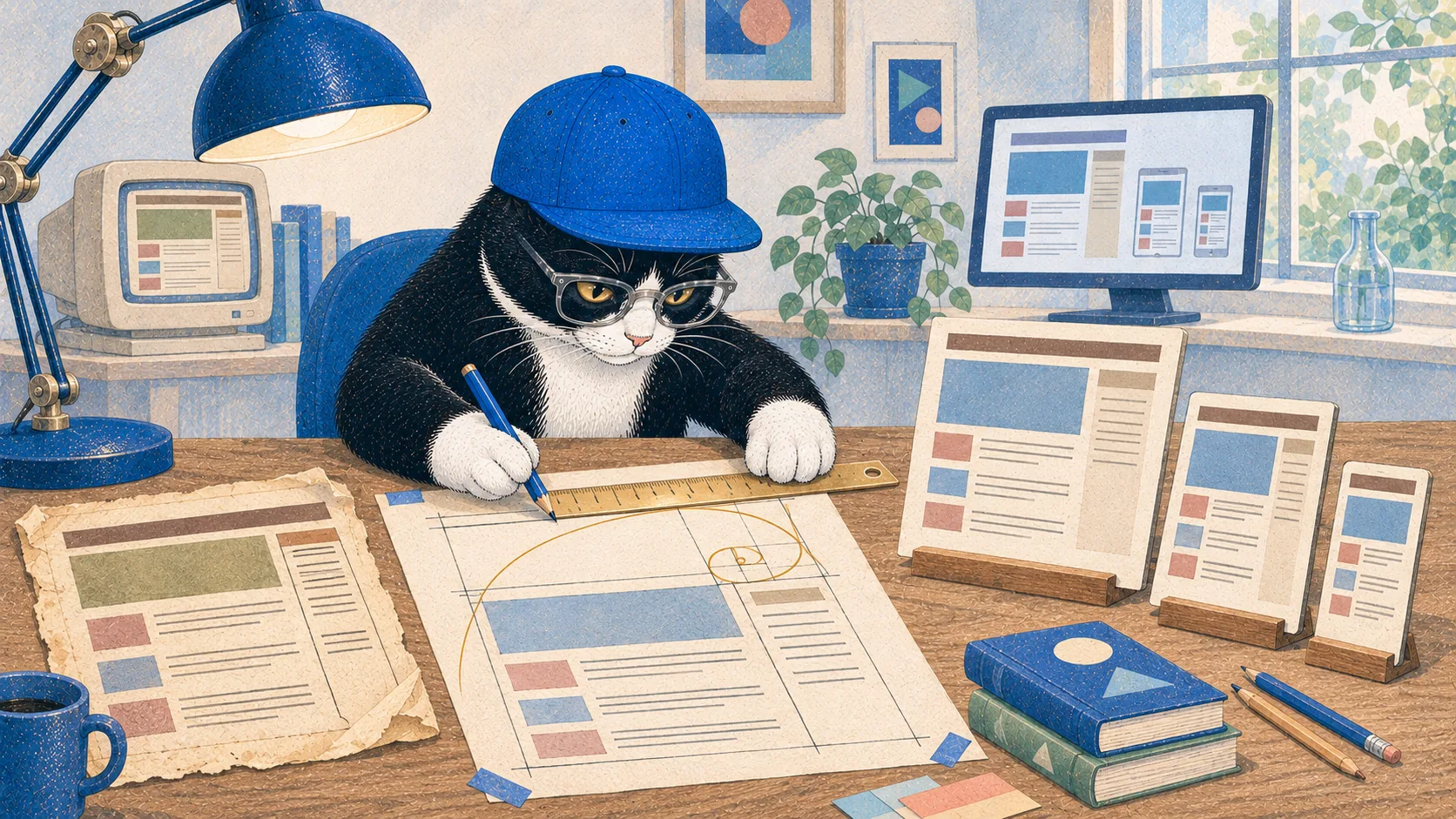
An old URL from 2008 kept appearing in my search statistics.
The page belonged to Una, the first WordPress theme I released publicly. The theme was gone, its download belonged to another era and the page needed a proper redirect.
The sensible solution was obvious.
Redirect it somewhere useful and move on.
Instead, I wondered whether Una should have somewhere new to go.
Maybe rebuilding it would recover some search traffic. That is hopeful thinking. But the more interesting question was whether the design itself still had anything worth preserving.
I went back to the archived Una post and looked at something I had made almost eighteen years earlier.
Some of it looked old.
The idea behind it did not.
The original Una
I built Una near the beginning of my WordPress career.
At the time, I was a front-end developer who had recently resigned from corporate work and started freelancing. Building WordPress themes was still relatively new to me. Una became my first free public theme release.
Its structure was simple but deliberate.
The homepage featured one large story followed by three recent posts with thumbnails. A useful sidebar held categories, recent comments, archives and other information. The two main columns followed what I called the divine proportion.
The original layout used a 580-pixel content column, a 360-pixel sidebar and a 20-pixel gap. The proportions were close to the golden ratio, although the implementation was still a fixed 960-pixel layout built for the web of 2008.
Una also required the usual WordPress machinery of that period. It used plugins, custom fields and direct template edits. Featured images relied on fields named post-thumb and post-image. Some configuration involved opening PHP files and changing particular lines.
That was normal then.
A few months after its release, Una won Best Free Custom Theme at the 2008 Philippine Blog Awards. Contemporary coverage still lists Una among the winners.
I was surprised.
I did not expect to win, but I was happy that something I had built early in my freelance career received that recognition.
The influence I left out
The original article credited several blogs that influenced Una, including Web Designer Wall, Matt Brett, Avalonstar and 5 Thirty One.
What I did not mention was one of its strongest visual influences: Microsoft’s Zune design language.
The iPod was the popular product at the time. Zune was the alternative that never achieved the same public success. To me, however, it looked more artistic and modern.
It appeared to have a stronger following among designers than among ordinary consumers.
There was something about its typography, generous spacing and visual confidence that stayed with me. It did not need to place every element inside a box. It allowed type, alignment and open space to organize the interface.
Those ideas found their way into Una, even if I did not write about the connection in 2008.
Looking at the old theme now, the parts I still liked were the same ones: the typography, the space and the use of proportion between the columns.
I do not think the design aged badly.
The fonts did.
Free web typography was limited in 2008. Designers could not assume that a visitor had a particular typeface installed, and the selection of freely available web fonts was small. Una used Arial and Verdana because those were practical choices.
Today, high-quality open fonts give us far more control. Una Moderno uses Inter throughout the system, which finally gives the large, light typography the character I wanted.
The better font did not merely decorate the old idea.
It completed it.
Why I did not rebuild a WordPress theme
The obvious approach would have been to turn Una into another WordPress theme.
That would also have repeated its original limitation.
This is a different period of the web. A layout might be used with plain HTML, a static-site generator, WordPress, EmDash or whatever publishing system comes next. AI-assisted development also makes it easier to adapt a well-defined design to different platforms.
Why lock the design to one of them?
I rebuilt Una Moderno around semantic HTML and CSS. The framework-neutral core is the source of truth. A page using the core does not require Node, Tailwind, a JavaScript framework or runtime JavaScript.
Tailwind is available as an optional layer rather than a second implementation. An Astro reference demonstrates how structured content can be mapped into the same markup.
WordPress is still a future adapter. EmDash remains an experimental mapping rather than a verified integration. I do not want to claim support that has not been built and tested.
The point of v0.1 is not that Una Moderno already works everywhere.
The point is that its design is no longer imprisoned inside one platform.
What stayed
Una Moderno is a new implementation. It does not reuse the old PHP, JavaScript, images or CSS.
What it preserves is the relationship between things.
There is still a leading story followed by three supporting stories. The sidebar remains useful rather than decorative. The columns retain the unequal editorial balance of the original, now using an exact 1.618:1 ratio with a fluid gap.
The typography is spacious. The composition is open. A few carefully placed elements are allowed to carry the page.
The new system also includes five optional panoramic artworks. They provide personality without becoming part of the underlying layout contract. A publication can select one, choose another or omit the artwork entirely.
On smaller screens, the reading column comes first and the sidebar follows. Navigation remains a single horizontal row that can scroll on phones. Keyboard focus, semantic landmarks, readable article widths and reduced-motion behavior are part of the foundation rather than corrections to add later.
The old theme was designed for a particular version of WordPress on desktop screens.
Una Moderno is designed to travel.
Building it with AI agents
I built Una Moderno using the same AI-assisted workflow I now use for other projects.
An AI agent creates a plan. I inspect it, correct the direction and approve it when it reflects what I actually want. The work then moves through repeated implementation, testing and review loops.
I used Paseo to orchestrate those agents.
The rebuild itself was not especially difficult because AI handled much of the mechanical work. The harder problem was making the result feel modern without erasing its connection to Una.
AI could generate code, compare layouts and run tests. It could not decide which parts of the old design deserved to survive.
That still required judgment.
The repository eventually accumulated a large amount of verification around what might appear to be a simple editorial layout. Its current checks cover the core CSS, token generation, Tailwind mapping, Astro output, artwork derivatives and local links.
That work matters because “portable” should mean more than claiming that some CSS can be copied somewhere else.
It needs a stable structure that another system can deliberately map into.
A foundation, not an ecosystem
Una Moderno v0.1 is usable today through plain HTML and CSS. It includes a complete static specimen, an optional Tailwind layer and an Astro reference.
It is not published to npm.
It is not currently a WordPress theme.
It is not an EmDash integration.
It is not a universal design system that solves every publishing problem.
It is a foundation.
Anyone can inspect the public GitHub repository, adapt the design, use the core or take the ideas somewhere else.
They can do whatever they want with it.
That is my contribution to the web.
Where the redirect leads
The old Una URL still needs a redirect.
When this essay is published, it will finally have somewhere appropriate to go.
Not to a restored copy of the 2008 theme. Not to a download pretending that eighteen years of web development never happened.
It will lead to the story of what the old theme became.
Good ideas do not have to remain trapped inside the technology that first contained them. Preservation does not always mean freezing something in its original form.
Sometimes it means identifying what was worth keeping, rebuilding it with the tools available now and letting it travel somewhere new.
Una began as a WordPress theme.
Una Moderno keeps the proportions, hierarchy and confidence that made it recognizable.
Everything else is free to move.