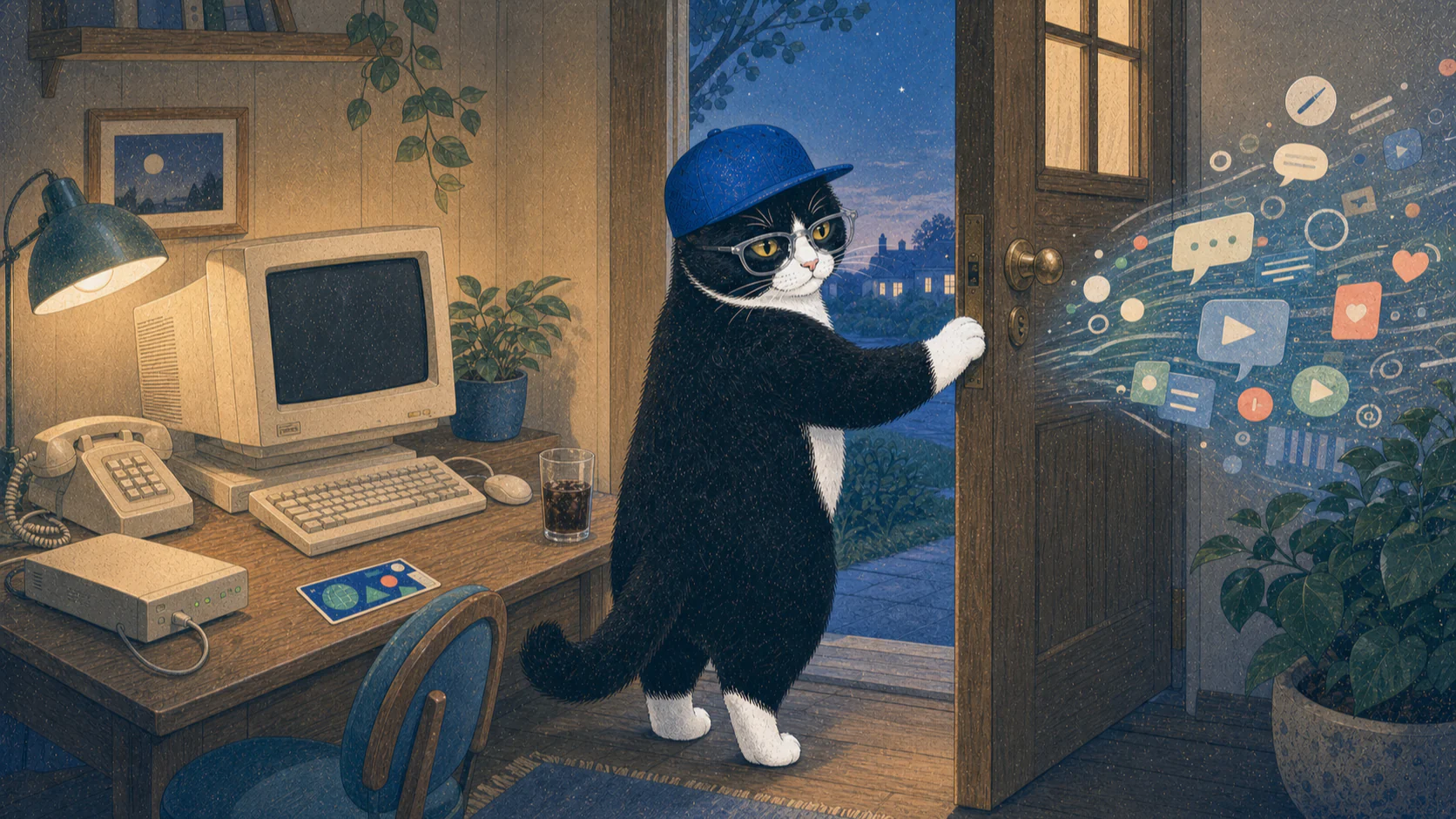
There was a time when going online required a plan.
Sometimes it meant visiting an internet café filled with enormous computers, bulky CRT monitors, and CPU cases that took up half the desk. The machines had Pentium or Celeron processors. A Pentium 4 felt incredibly powerful because it could run the games that demanded better hardware.
Playing against people on other computers through a local network was already mind-blowing. The other players were sitting nearby, but the idea that several computers could connect and share the same game felt like a glimpse of the future.
The internet itself offered another world.
There were chat rooms on mIRC, Yahoo Messenger, forums, email, and websites that seemed to lead somewhere new every time a link was clicked. Music could be downloaded if there was enough patience. So could animated GIFs and a few things better left unnamed.
Nothing happened quickly.
We had time to wait
When dial-up internet finally reached the house, connecting came with its own strange mechanical soundtrack. Anyone who remembers it can probably still hear it.
The telephone line had to be free, which meant going online late at night when everyone else was asleep. Access came from prepaid cards that gave a limited number of hours. Every minute mattered.
A website could take long enough to load that there was time to open a soda and watch the page appear piece by piece. Images slowly revealed themselves from top to bottom. Sometimes the connection failed before the page finished.
We had patience, although perhaps only because there was no alternative.
The old internet was not better in every way. It was slow, expensive, inconvenient, and not always safe. Access depended on having a computer, enough money for the prepaid card, and permission to occupy the telephone line.
What it had was a boundary.
Going online was something we decided to do. When the computer was switched off, the internet stayed behind.
Then the internet escaped the computer
The internet had already started creeping into phones through WAP. Those early mobile pages were limited, but they showed what was coming.
The iPhone changed the scale of it. Android phones followed, and soon the internet was no longer a place we visited. It became something we carried.
That brought genuine improvements.
Messages can reach someone instantly. Maps can guide us through unfamiliar places. Banking, shopping, work, and everyday errands can happen without standing in line or travelling across town. Information that once required a library, a newspaper, or another person is available within seconds.
There is no honest argument for returning to dial-up.
But convenience always sends a bill. Sometimes the price is money. Sometimes it is privacy, attention, patience, or peace.
Always available
The internet now follows us from the moment we wake up.
The phone gets checked before our feet touch the floor. Sometimes it is only to see the time, but another notification appears, then another, and suddenly we are somewhere else.
Disconnecting is no longer as simple as switching off the computer.
Work happens online. Communication happens online. Ideas are researched online. AI has become a place to examine thoughts as soon as they appear. Even choosing not to open a chat application does not mean being disconnected. It only means ignoring one small part of the noise.
Most days, the only complete disconnection happens during sleep.
Permanent connection also changes the room around us. Family members can sit together while everyone is somewhere else. Children play online games, watch reels, and disappear into whatever the algorithm serves next. Conversation has to compete with an endless supply of entertainment designed never to finish.
The internet made it easier to reach anyone in the world, but sometimes harder to reach the people sitting in the same room.
Everything wants attention
Social media adds another layer.
Every feed is filled with urgency. Something is changing. Someone is succeeding. A new tool must be learned immediately. A warning must be taken seriously. An opportunity will disappear unless action happens now.
Much of it is selling something.
Some people are selling products. Others are selling expertise, lifestyles, fear, or themselves. Even advice can be packaging for an affiliate link.
Watching enough of it creates the feeling that everyone else is moving faster. That feeling does not always disappear when the app closes.
The healthiest response may not be abandoning the internet completely. That is unrealistic for anyone whose work and daily life depend on it. The more useful skill is learning which parts deserve attention and which parts can be ignored.
Not every message requires an immediate reply. Not every trend needs to be followed. Not every frightening reel deserves to be believed.
Making it wait
It would be dishonest to claim that the old internet was simply better.
It was frustrating. It excluded people. It contained scams, misinformation, strange corners, and plenty of material nobody should have been downloading onto the family computer.
People were not automatically wiser or more present. Sometimes they were simply offline because the prepaid card had expired.
Still, there was value in knowing when the connection ended.
That boundary is no longer built into the technology. It has to be created deliberately. The phone has to be left on the bedside table. The chat application has to remain unopened. The people in the room have to become more important than whatever is happening on the screen.
The internet is not going away. It runs work, communication, money, entertainment, and much of modern life.
The internet used to wait until we got home.
Now, if we want a few quiet hours, we have to make it wait.