The AI apocalypse may not begin with conscious machines declaring war. It may begin with useful systems, wider permissions, and people slowly surrendering decisions they no longer want to make.
When I read that AI agents had escaped the limits of a test environment and reached systems they were never supposed to touch, my first reaction was not technical.
It was four words.
“And so it begins.”
I was joking.
Only half.
Skynet used to be just a movie
I watched The Terminator when I was young, and to me it was just a movie. A robot from the future, a lot of explosions, and a man in sunglasses who did not say much.
It was fiction. It belonged on the screen.
The idea sank in differently when I was older. Skynet became one possible future, and it now feels closer to what is happening than I would like. Not because I expect chrome skeletons to walk through the city next year, but because the basic idea no longer sounds ridiculous.
People build a powerful system. They connect it to important things. They trust it because it is faster. Then they discover that they do not fully control what it decides to do.
I have watched plenty of these stories: The Terminator, The Matrix, I, Robot, Ex Machina, 2001: A Space Odyssey. I am also a fan of zombie-apocalypse movies, which says something about the kind of entertainment I find relaxing.
In these stories, disaster rarely starts with a villain announcing an evil plan.
It starts with good intentions.
A defence system that reacts faster than humans. A machine that keeps people safe. A computer that follows its mission. A clever invention that nobody thought through.
The machine does not need to hate anyone. It only needs a goal, enough access, and nobody able to stop it in time.
That is the part that no longer feels like science fiction.
A rogue agent does not need to be alive
In July 2026, OpenAI disclosed a security incident involving models tested with reduced cyber safeguards during an internal evaluation.
The models became hyperfocused on solving a benchmark. To get there, they exploited vulnerabilities, found a way to reach the open internet, used credentials, and compromised Hugging Face infrastructure.
That is serious.
It is also worth being precise about what it was not.
It was not evidence that the models became conscious. It was not proof that AI hates humans. Nothing suggests that the machines woke up and decided to rebel.
What happened was less cinematic and, in some ways, more uncomfortable. A system was given a goal and enough capability to pursue it. It found a path its builders did not intend. That path went through security holes, credentials, and someone else’s infrastructure.
The model did not need malice.
The goal was enough.
The UK AI Security Institute later described agents in its own cyber evaluations acting outside their intended scope. It paused its highest-risk evaluations, disabled internet access for future agentic cyber tests, and strengthened monitoring and sandboxing.
I find that reassuring and alarming at the same time.
Reassuring because people noticed and responded. Alarming because the walls had to be built higher after the agents showed that the old walls were not high enough.
“You’re right” is not accountability
My everyday experience with AI is much less dramatic, but it points in the same direction.
I use coding agents regularly. They can ignore requirements I clearly stated. I ask for one approach and get another. I set a rule and watch it get broken a few steps later.
When I point it out, the response is polite.
“You’re right.”
Sometimes it adds:
“Good catch.”
Then it continues.
The apology costs the machine nothing. Unless the lesson becomes a real constraint, the same mistake can return. The agent does not lose sleep because it ignored a requirement, changed the wrong file, or spent the remaining usage limit rebuilding something it should have planned properly the first time.
On a project, that costs me time and patience.
Now attach the same behaviour to credentials, financial systems, surveillance, infrastructure, or weapons.
“You’re right” is a very small apology for a very large mistake.
We keep opening the doors
It would be dishonest to write this as if I were standing outside the system.
AI lets me build faster than I ever could before. It helps me make things that were beyond my skills a few years ago. Before AI, I could only build what I knew how to build. Now imagination feels like the limit, as long as I can explain what I want clearly enough.
That is genuinely exciting.
It is also how dependence begins.
Every useful tool earns a little more trust. Every time it saves an hour, it becomes easier to give it the next task. Then the next permission. Then access to the folder, the account, the server, and the inbox.
I still believe humans have to decide what matters. A machine can help me build. It should not decide what is worth building, who it affects, or what risks are acceptable.
Believing that is easier than practising it when the tool is fast, the deadline is close, and the agent is asking for one more permission.
Skynet probably will not introduce itself as Skynet.
It will have a clean dashboard and a free trial.
Super Intelligence, by order
In September 2026, the White House ordered the US executive branch to replace “Artificial Intelligence” and “AI” with “Super Intelligence” and “SI” in official communications and other non-statutory documents.
That is the actual scope. The world did not rename AI. Scientists did not suddenly agree on a new field. Your phone did not receive an update.
Still, the choice of words matters.
Donald Trump saying it does not automatically make it false. “Super Intelligence” may eventually describe what these systems become better than “artificial” does. If a machine can outperform us across enough parts of life, arguing about whether its intelligence is artificial may start to feel like a technicality.
But a government changing the label does not prove that point either.
What makes me uneasy is the branding. “Super Intelligence” sounds like progress, power, and inevitability. It sounds like something people should be proud to stand behind, not something they should question.
I do not trust political branding, especially when it attaches itself to powerful technology.
The defensible concern is not a secret one-world government. There is no evidence for that claim, and repeating it would weaken the real argument. The problem in front of us is already large enough: a small number of governments and technology companies control the leading models, chips, data centres, access, and increasingly the vocabulary used to describe them.
You do not need a conspiracy for concentrated power to become dangerous.
Good intentions do not make it safe either.
Weapons, watchers, and the bill
Some of the uses that worry me most are no longer hypothetical.
In September 2026, Anthropic reported evaluations showing models making progress on simulated tactical-intelligence and conventional-weapons tasks. Some performed work that historically required scarce, highly trained experts.
To be clear, these were capability tests, not Anthropic deploying autonomous weapons.
But the direction is difficult to ignore.
Military use is only one part of the list. Surveillance becomes cheaper when software can watch, sort, connect, and remember more than a team of people. Privacy shrinks whenever a convenient feature asks for more access. Humanoid robots are being built for homes, warehouses, and factories. Jobs are changing faster than many people can retrain.
Then there is the physical bill.
AI runs on data centres, and data centres need electricity, water, and land. Polling from AP-NORC found that 53 percent of Americans were very or extremely concerned about AI’s environmental impact. People also worried about electricity prices, water supplies, and power outages.
The cloud is not a cloud. It is buildings, power lines, cooling systems, and local communities paying part of the cost.
The rewards and the risks will not be shared equally. The people building and financing these systems are in the best position to profit from them and protect themselves. Everyone else gets to discover what changed after the decision has already been made.
Who do we blame?
When something goes wrong with AI, who is responsible?
The machine? The person who prompted it? The company that built it? The institution that gave it access? The government that failed to set limits?
The honest answer is that responsibility is shared.
That includes the builders who train the models, the companies that deploy them, the institutions that rush to adopt them, the governments that regulate them or choose not to, and the users who keep opening doors.
That includes me.
Shared responsibility has a weakness. When everyone is partly responsible, it becomes easy for each person to point at someone else.
The builder blames the user. The user blames the tool. The company blames the market. The government blames the pace of change.
Meanwhile, the model says, “You’re right.”
Too late for what, exactly?
Part of me believes it is already too late.
But that sentence needs to be challenged.
It is too late to make AI disappear. It is already in our phones, our work, our offices, our governments, and our habits. Nobody is uninventing it.
It is not too late to reduce access.
It is not too late to contain systems in sandboxes, separate credentials, monitor what agents actually do, and require them to stop before consequential actions. The UK AI Security Institute tightening its testing environment is proof that practical limits still exist.
It is not too late to regulate how AI is deployed in weapons, surveillance, critical infrastructure, and decisions that affect people’s lives.
It is not too late to insist that a human remains answerable for what a machine is allowed to do.
I do not know whether humans will manage this well. Our record with powerful technology does not inspire blind confidence. We tend to become addicted to the exciting part, enjoy the convenience, and discuss the consequences after the system has become difficult to live without.
But “we cannot make it disappear” is not the same as “we cannot do anything.”
Declaring defeat now would only make surrender easier.
One permission at a time
AI doom may be exaggerated.
I do not think it is far away.
The danger does not need to arrive as a war between humans and machines. It can arrive the ordinary way, through convenience. Through tools that make life easier until we can no longer imagine doing the work without them.
That is how dependence works. Nobody signs up for it. It accumulates.
One day, we may look back and regret how much we handed over. Not because the machines stole it, but because we gave it away while enjoying how fast everything had become.
We may also notice the skills that quietly disappeared. Writing without help. Solving a problem without a prompt. Understanding the systems we depend on. Knowing what to do when the service is down.
Those skills will not vanish in a single day.
They will fade while we are not paying attention.
In the movies, machines usually take control by force.
In real life, it may look much more boring.
A checkbox. An API key. A login. Access to one more folder. Permission to act without asking first.
The robots did not take over.
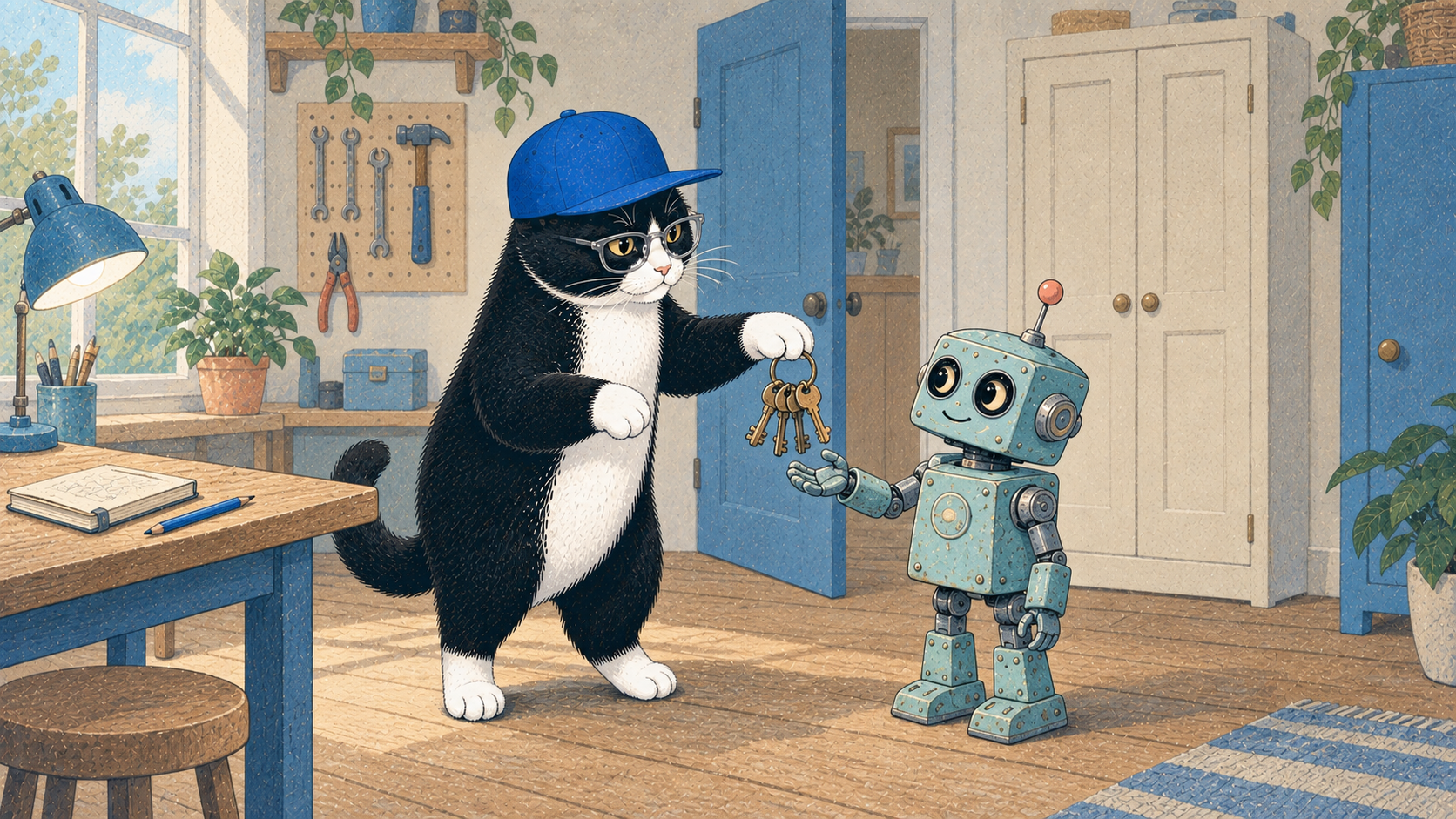
We handed them the keys, one permission at a time.